Inside the H-House Exotic Skins: Grade 1 vs Grade 3 Crocodile Leather
Wondering if your exotic bag lives up to its price? Many ask why patterns look asymmetrical. You might not have a fake, but you likely paid Grade 1 money for Grade 3 commercial skin. We compare Porosus, Niloticus, and Alligator to show how pore clarity and scale symmetry reveal the truth.
--Stop Falling for the "Natural Wild Flavor" Gaslighting.
Industry Reality Check:
Let's be direct: True exotic builds command a high four-figure price tag just to cover the raw material costs. If you are hunting for a $300 or $500 miracle, close this page. This insider guide is exclusively for serious collectors ready for true Grade 1 perfection and want to see exactly where the money goes.
When shopping for an exotic bag, most buyers head straight to Google or social media to search: "How to spot a fake crocodile bag?", "Are small scars normal?", or "Why is my pattern asymmetrical?"
Here is the hard truth: You might not have bought a fake, but you very likely paid Grade 1 money for Grade 3 commercial-grade leather. Resellers and tier-three factories will never voluntarily share the secrets of raw hide grading with you. To them, your ignorance is their profit margin. Today, this leather archive is putting Grade 1 (the standard for top-tier custom ateliers) and Grade 3 (mass-market chemically treated leather) under the magnifying glass. Bookmark this guide to inspect your own collection.
BEFORE YOU START: Want to see what a real Grade 1 Hermes exotic bag looks like under a 10x macro lens? We have archived hidden studio catalog photos from top-tier custom ateliers showing the exact scale alignment and pore details of Porosus, Alligator, and Niloticus. 👉
(Password protected - Free for active Wiki members).
🖼️ Shiny Porosus Crocodile — Is an Indistinct Pore a Sign of a Fake?
Porosus (marked by the caret ^ stamp) is universally recognized as the "King of Exotic Skins." However, many buyers freak out when they receive their bag and notice oversized scales or messy symmetry, fearing they got a defective piece.
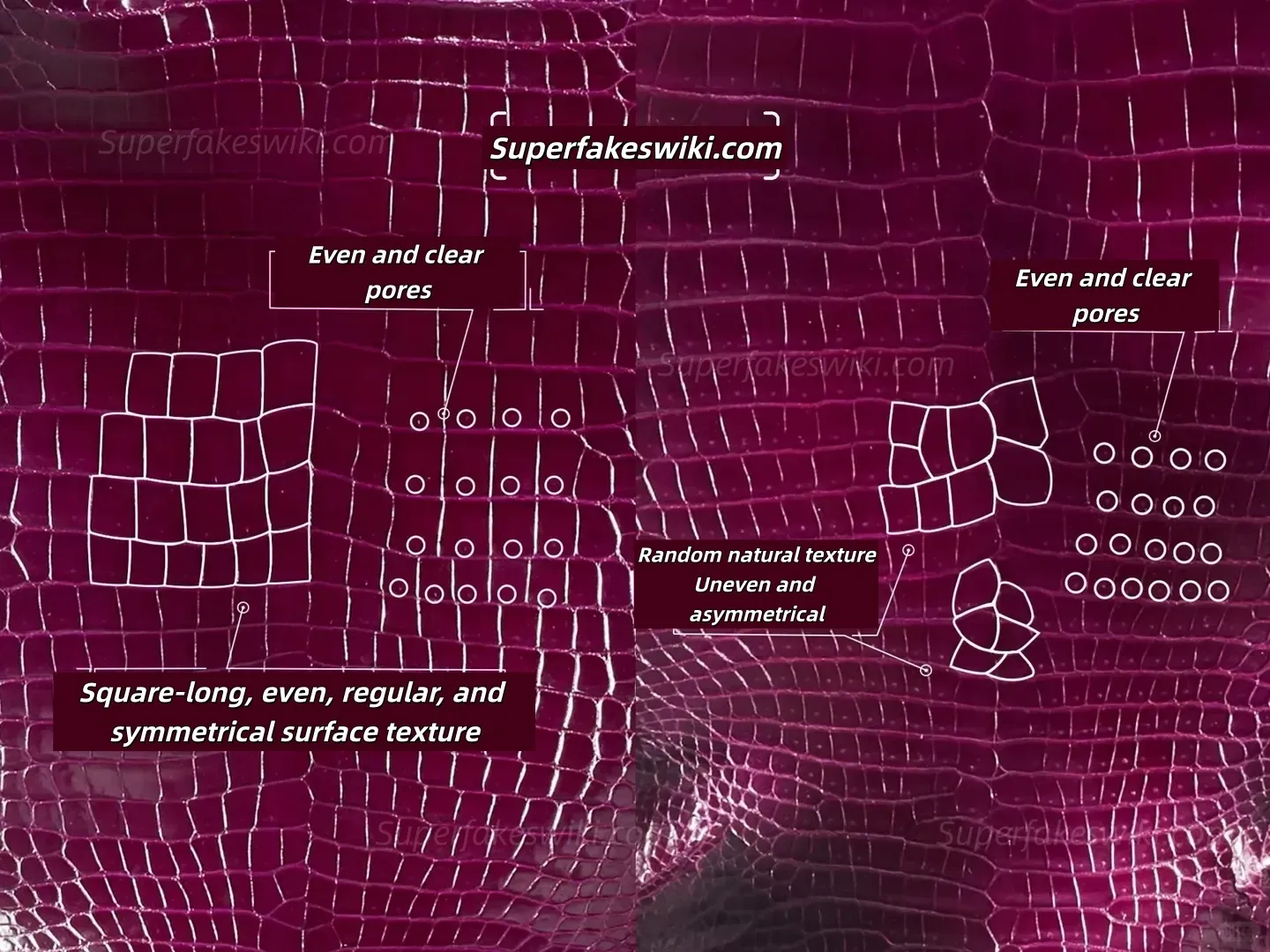
- 【Left】Grade 1: The scale pattern is remarkably symmetrical, uniform, and well-regulated. The ultimate telltale sign here is that the pores (sensory pits) are evenly distributed and razor-sharp. That iconic "soul dot" on the edge of each scale is highly visible, instantly elevating the bag's luxury texture.
- 【Right】Grade 3: The natural scale pattern is chaotic with zero sense of symmetry. Because the raw hide originally had too many scars, it underwent heavy buffing and intense chemical glazing. As a result, the pores are barely visible or have been completely sanded flat. This isn't a difference of authenticity; it's a massive gap in leather grade.
🖼️ Matte Alligator — Why Does It Feel Stiff? Is a Thick Center Seam Normal?
Alligator (marked by the square □ stamp) naturally lacks pores, meaning its entire aesthetic relies on the geometric beauty of its rectangular "bamboo" scales. But why do some alligator bags feel incredibly stiff, with a center seam (spinal ridge) bulging out like a centipede?
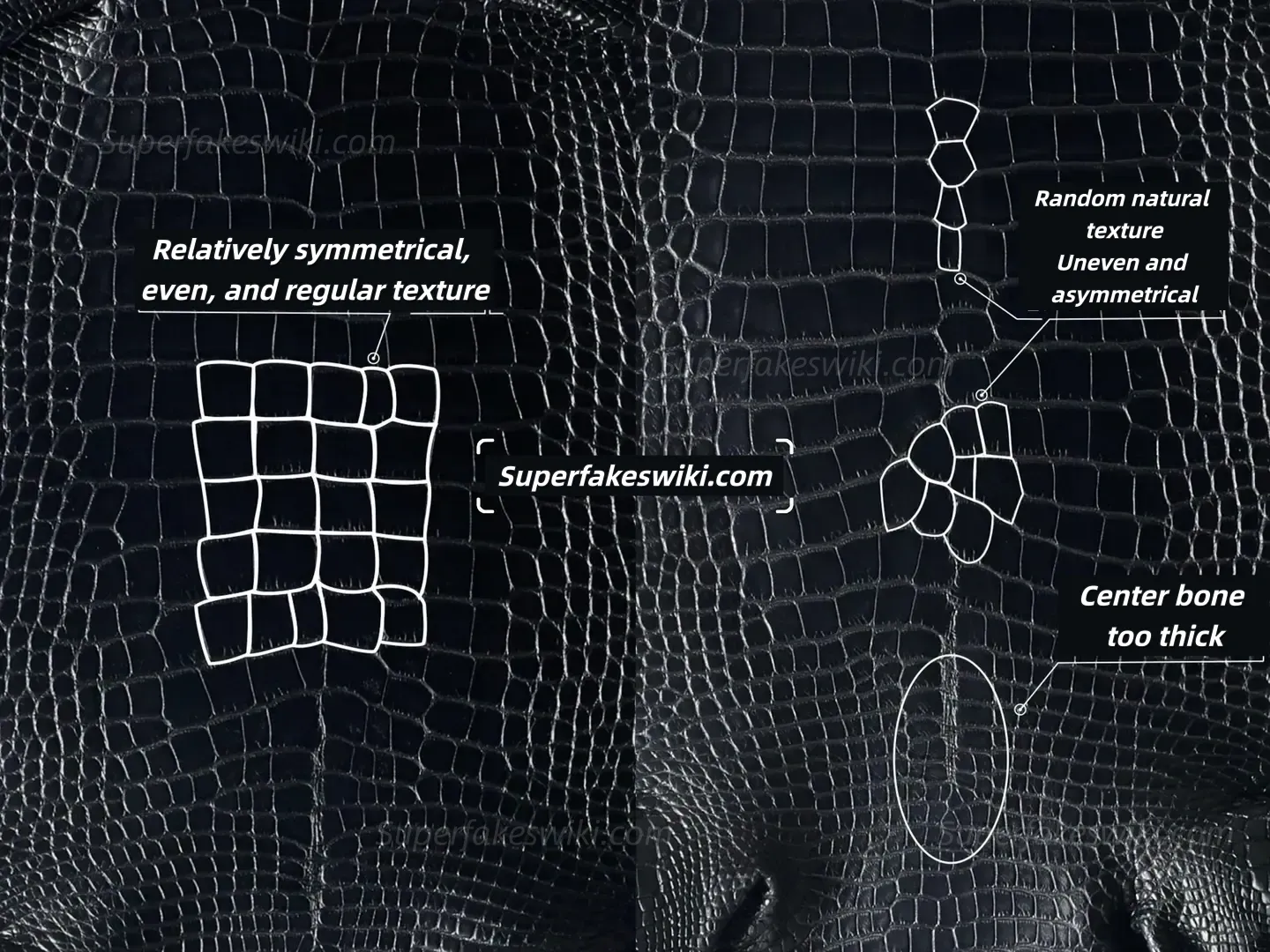
- 【Left】Grade 1: The scale pattern is long, perfectly rectangular, uniform, and highly symmetrical. The transition from the belly center to the side flanks is seamless, preserving the hide’s natural, supple pliability. It feels soft and organic to the touch.
- 【Right】Grade 3: The natural scale pattern is irregular and asymmetrical. The fatal flaw here is that the umbilical scar/center bone is excessively thick. This not only ruins the flat silhouette of the bag but also indicates rigid, stiffened leather fibers that feel unyielding and lifeless.
🖼️Shiny Niloticus Crocodile — Asymmetrical Scales? Are You Being Fleeced?
Niloticus (marked by the double dots •• stamp) naturally features larger scales than Porosus. The biggest fear for premium buyers is a reseller passing off cheaper Alligator as Niloticus, or using low-grade flank pieces and scrap leather to piece together the front panel.
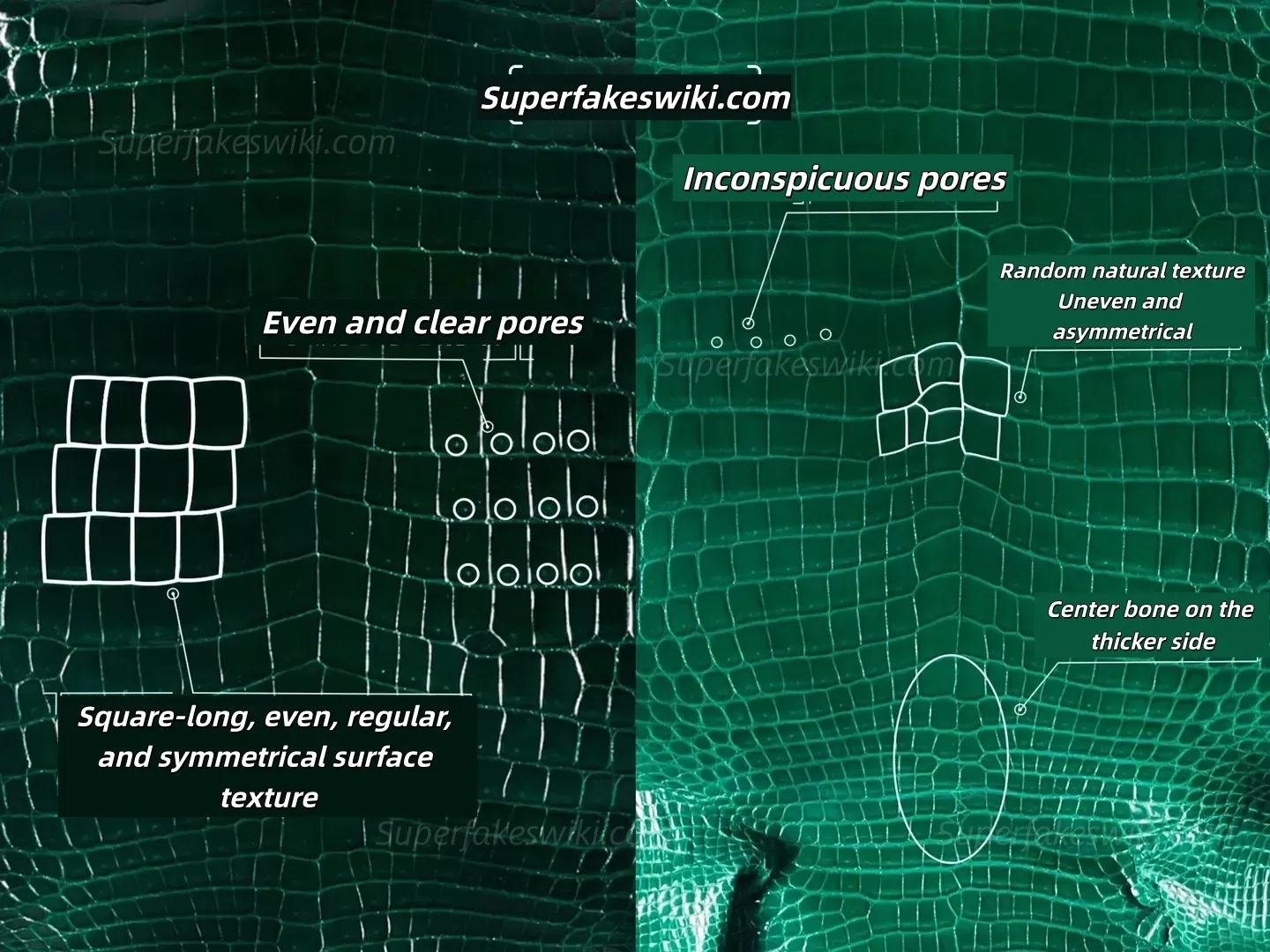
- 【Left】Grade 1: Despite the inherently larger scale size, a Grade 1 hide maintains a highly symmetrical, uniform, and perfectly aligned tile pattern across the central belly axis. Furthermore, the pores remain sharp and clearly defined.
- 【Right】Grade 3: A notably coarse center ridge causes the entire hide to warp and tighten unnaturally. The natural scale pattern is erratic and asymmetrical, leaving you with large scales on one side and small scales on the other. This cheap visual layout is impossible to hide.
🖼️ Shiny Alligator — Are Tiny Scars on the Glaze Really "Wild Badges of Honor"?
Shiny Alligator is the go-to choice for small leather goods or rigid Birkin/Kelly Sellier styles. It is incredibly frustrating when you catch the light on the bag's surface and notice tiny faint marks resembling fingernail scratches. Resellers love to claim this is just "natural wild scarring." Is that valid, or just a lazy excuse?
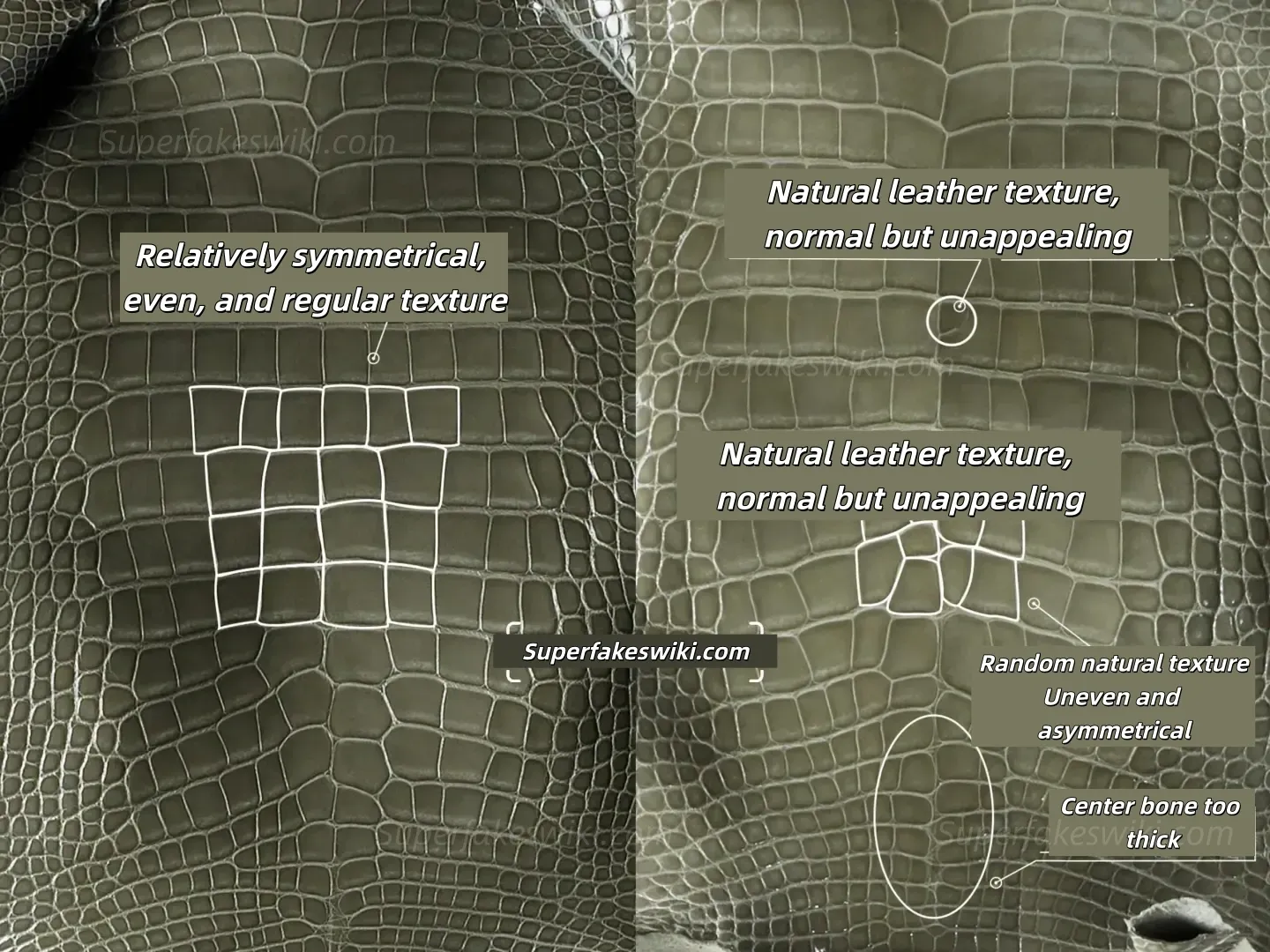
- 【Left】Grade 1: The selection process is brutal. Master cutters position the templates to flawlessly bypass any surface trauma. The scale pattern remains perfectly rectangular, uniform, and symmetrical, reflecting a flawless, mirror-like gloss under light.
- 【Right】Grade 3: A closer look reveals undeniable natural hide scars—which are indeed authentic markers, but highly unsightly. The seller didn't lie to you about it being real leather; they just omitted the fact that only bottom-tier Grade 3 hides force these ugly scars into the most prominent panels of a bag.
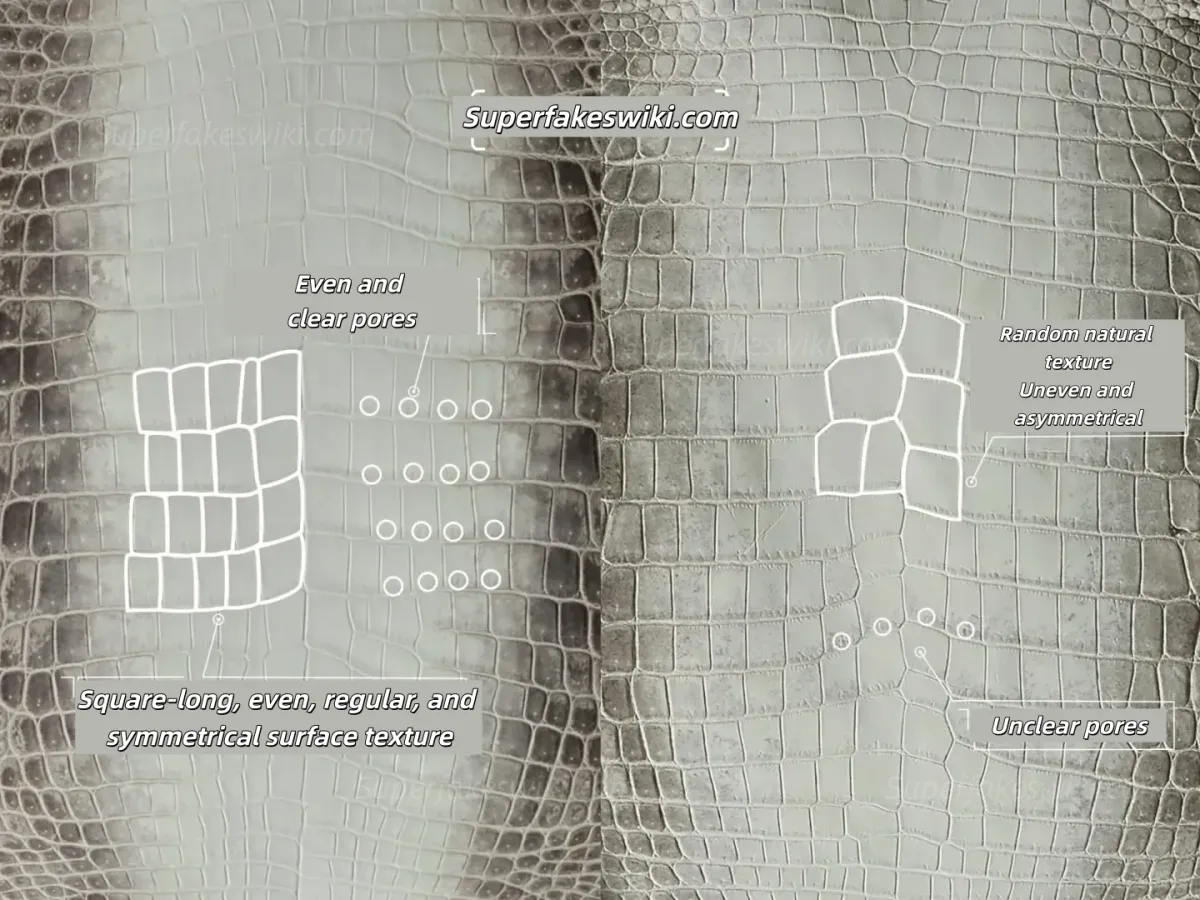
🖼️ Matte Himalaya Niloticus — Why Do Some Pieces Look So "Dirty"?
As the ultimate holy grail of exotic skins, the Himalaya relies entirely on the raw hide's natural pigment removal and buffing process—zero dye is added. The most common question among high-end buyers is: Why does my friend’s Himalaya look pristine and majestic, while mine looks dusty and graying?
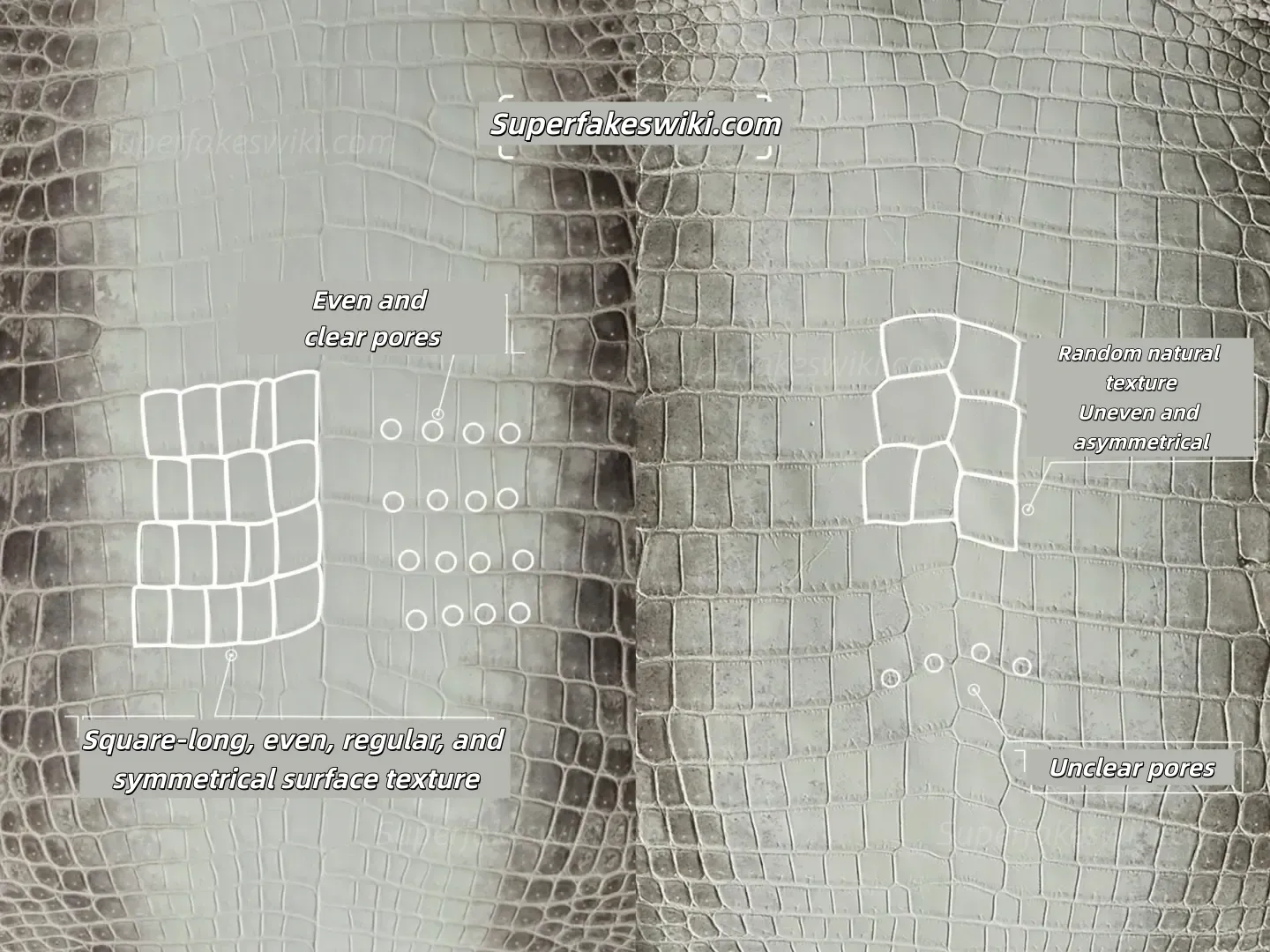
- 【Left】Grade 1: Exceptional purity. The scale pattern is long, uniform, flawlessly regular, and perfectly symmetrical. The graduation from the rocky-gray flanks to the snow-white center is seamlessly balanced, and the pores are incredibly sharp and distinct, retaining the organic vitality of the skin.
- 【Right】Grade 3: The raw hide is plagued with impurities. The natural pattern is messy and asymmetrical, often with the gray gradient appearing wider on one side than the other. Because the base hide was poor, factories rely heavily on powder coating and thick chemical finishes to mask flaws, resulting in indistinct pores and an un-washable, muddy "dirty look."
💡 Superfakeswiki Insider Takeaway
Too many casual buyers get stuck on the basic, amateur question: "Is this real crocodile?"
Those heavily marketed phrases like "natural flaws" or "wild character" are often just coping mechanisms invented by the commercial market to justify the low cost of inferior hides.
In the elite tier of custom craftsmanship, authenticity is merely the baseline, not the selling point. The raw hide grade (Grade 1 vs Grade 3) is what actually dictates the visual impact and true value of the bag. Grade 3 skins require heavy topcoats and chemical fillers to hide their blemishes, making them highly prone to cracking and losing their luster over time. Grade 1 leather, with its natural symmetry and pristine pores, offers a level of organic luxury that no industrial treatment can ever replicate.
🏁 Ready to skip the reseller markups?
Don't gamble your hard-earned money on Grade 3 leather passed off as premium. The elite custom ateliers who secure genuine Grade 1 hides do not advertise on public platforms. We have done the dirty work for you.
 SuperFakesWiki
![[Trusted Sources] Top-Tier Luxury Bags: Chanel, Hermès, Dior, LV & Core Elite Houses](/content/images/2026/06/1738141322538-homepagecorpoonedesktop23jpg_3240x5760.jpg)